Let’s be honest, finance has always been about precision. But today, precision alone isn’t enough.
Finance teams are drowning in data, facing tougher compliance checks, and under pressure to deliver insights faster than ever.
Here’s the catch, AI won’t replace finance professionals. But finance professionals who use AI will replace those who don’t.
The right AI tools for finance don’t just save time. They reduce errors, detect risks early, and help finance teams focus on strategy instead of spreadsheets.
And after researching and seeing how professionals actually use them, I’ve rounded up the 10 best AI tools for finance in 2025.
Think of this as your shortcut to figuring out which tools are worth your attention and how they fit into real-world finance workflows.
- 1. Workiva – Compliance and Reporting With Built-in AI
- 2. MindBridge – Fraud Detection With 100% Transaction Analysis
- 3. Datarails – FP&A Automation for Excel Lovers
- 4. Cube – Collaborative FP&A and Scenario Modeling
- 5. DataSnipper – Automating Audits and Reconciliations in Excel
- 6. Ramp – AI-Powered Expense Management
- 7. Brex – Smart Corporate Card & Spend Control
- 8. Validis – Financial Data Extraction at Scale
- 9. Power BI with Copilot – Ask Finance Data in Plain English
- 10. Alteryx – No-Code Analytics for Complex Financial Data
- Choosing the Right AI Tool for Your Finance Team
- Conclusion
1. Workiva – Compliance and Reporting With Built-in AI
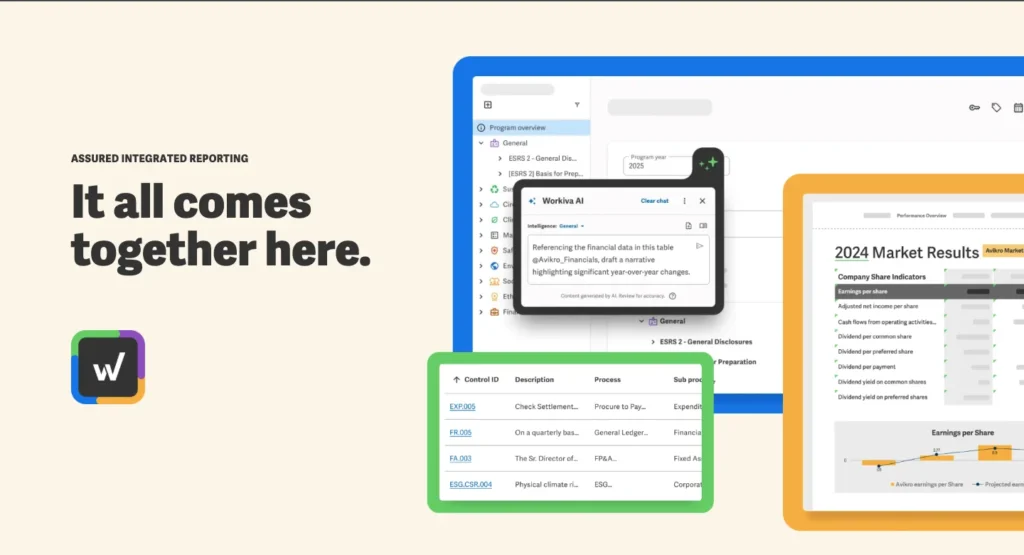
Compliance deadlines keep tightening, and manual reporting leaves too much room for error. Workiva solves that by combining financial reporting, SOX compliance, and ESG disclosures on a single cloud platform now powered by generative AI.
Why it matters:
Instead of juggling multiple systems, Workiva links data, documents, and workflows. Its AI assistant even drafts narratives based on your actual reports.
Finance use cases:
- Auto-generate working paper links and PBC requests for SOX testing.
- Standardize ESG reporting with audit-ready traceability.
- Collaborate on regulatory filings across teams.
Real-world example:
A Fortune 500 company used Workiva’s GenAI assistant to prepare ESG disclosures, cutting prep time by weeks while maintaining compliance traceability.
Best for: Enterprises with heavy compliance and reporting needs.
2. MindBridge – Fraud Detection With 100% Transaction Analysis
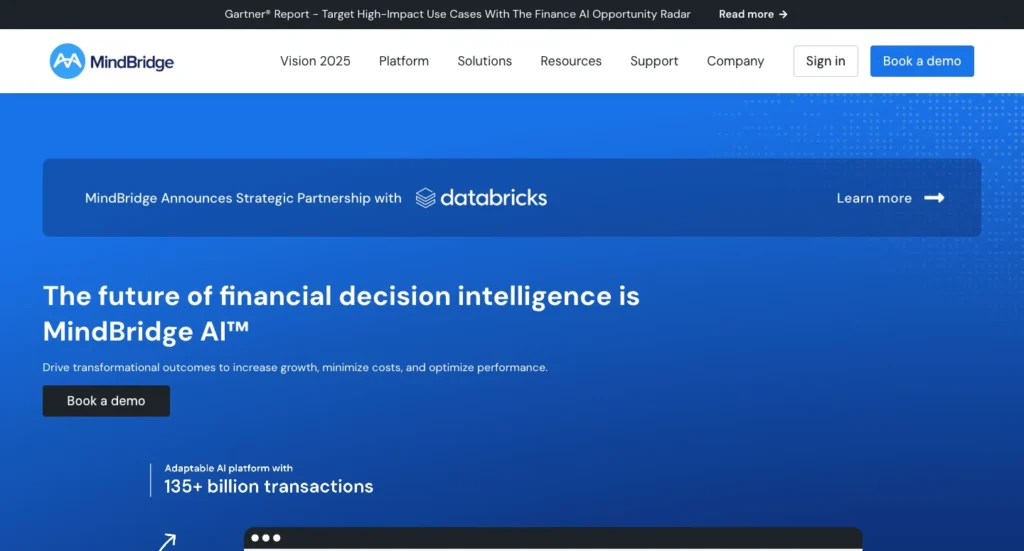
Fraud usually hides in the 1% of transactions most teams never review. MindBridge changes that by analyzing every single journal entry and scoring them for risk.
Why it matters:
Traditional audits rely on samples. MindBridge checks 100% of your data, flagging anomalies in real-time.
Finance use cases:
- Spot fraudulent or suspicious journal entries before audits.
- Continuous monitoring for compliance breaches.
- Detect internal control weaknesses.
Real-world example:
A mid-sized bank used MindBridge to analyze millions of transactions, uncovering subtle duplicate payments their legacy systems never flagged.
Best for: Auditors, risk managers, and compliance officers.
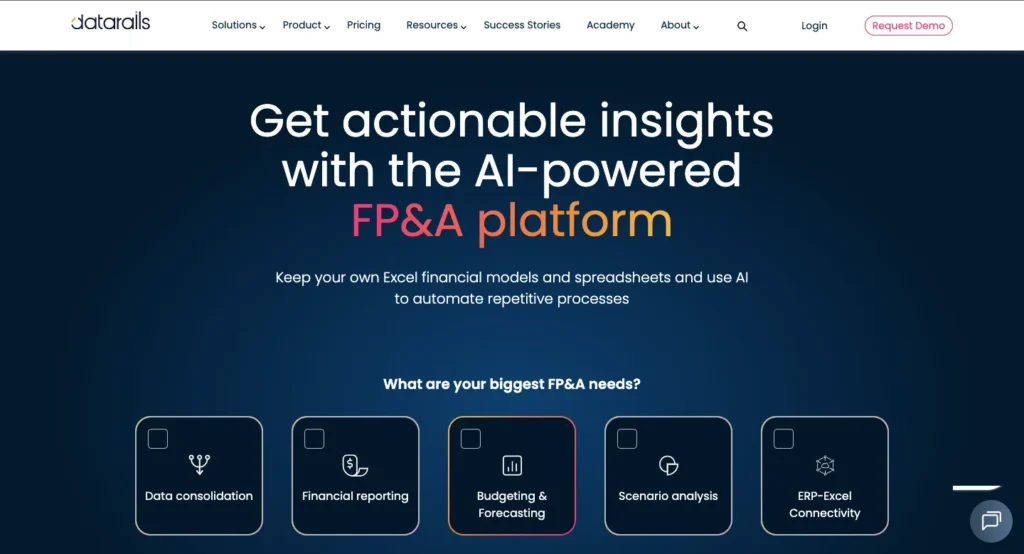
3. Datarails – FP&A Automation for Excel Lovers
Budgeting, forecasting, and consolidation are some of finance’s biggest time drains. Datarails solves that by plugging into your existing Excel workflows and layering AI on top.
Why it matters:
Instead of building complex models from scratch, finance teams can run “what-if” scenarios or consolidate forecasts automatically.
Finance use cases:
- Centralize budgets and refresh them automatically.
- Run rolling forecasts with live data feeds.
- Automate variance analysis in Excel.
Real-world example:
A SaaS CFO used Datarails to consolidate departmental budgets across 15 teams. What used to take two weeks now takes just two days.
Best for: Finance teams that want automation without leaving Excel.
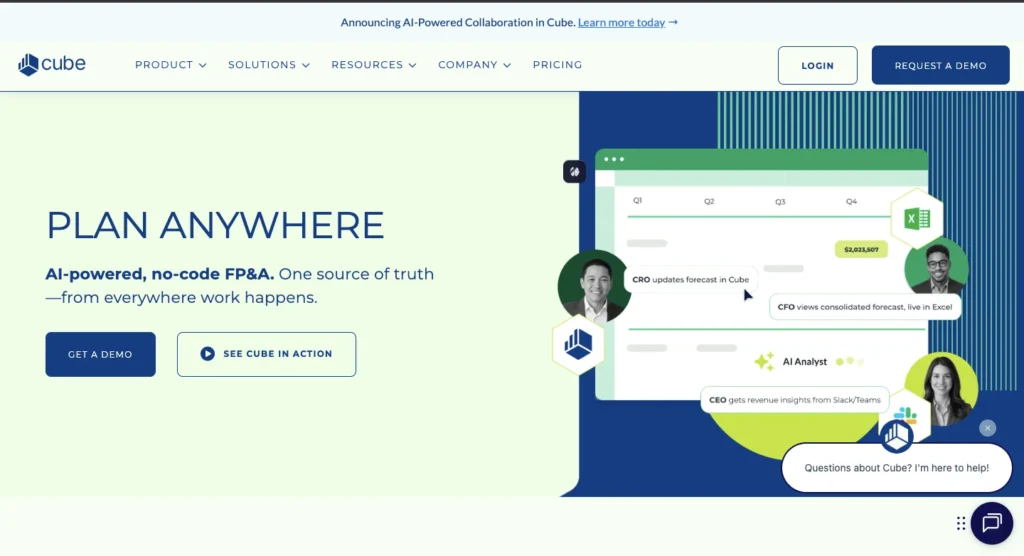
4. Cube – Collaborative FP&A and Scenario Modeling
If Datarails feels like “Excel on steroids,” Cube is more like “Excel with teamwork.” It connects spreadsheets with your ERP, supports rolling forecasts, and even lets you query financial data in plain English.
Why it matters:
Instead of waiting for IT or analysts, managers can get instant insights themselves.
Finance use cases:
- Run continuous planning and live scenario modeling.
- Ask Slack: “What’s our Q2 revenue variance by product line?” and get a chart back.
- Share rolling forecasts across finance and ops.
Real-world example:
A SaaS startup’s FP&A team used Cube to roll out weekly forecasts. By cutting manual consolidation, they spotted a revenue dip three weeks earlier than usual.
Best for: Finance teams needing collaboration across departments.
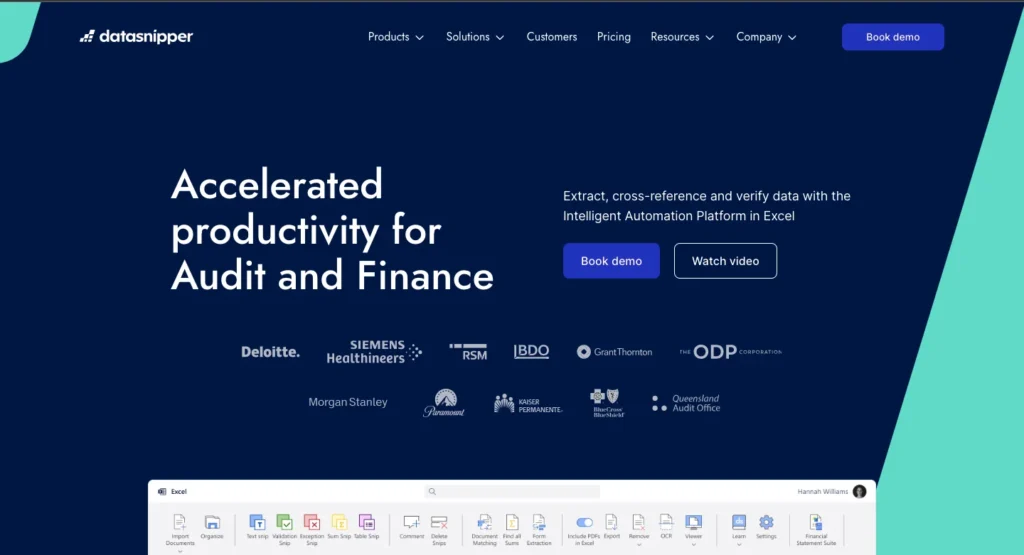
5. DataSnipper – Automating Audits and Reconciliations in Excel
If your day revolves around Excel, DataSnipper will feel like magic. It’s an intelligent automation add-in that lives inside Excel, automating reconciliation, audit testing, and documentation.
Why it matters:
Most auditors and accountants spend hours matching transactions, invoices, and contracts. DataSnipper reduces that to minutes by linking documents directly inside Excel.
Finance use cases:
- Match invoices to bank transactions for SOX testing.
- Automate ESG or regulatory reporting by pulling line-item evidence.
- Create audit-ready workpapers with full traceability.
Real-world example:
One Big Four audit team used DataSnipper to automate bank statement matching and cut the reconciliation process by 70%. Instead of chasing down missing documentation, they could focus on analyzing risks.
Best for: Auditors, controllers, and finance pros who practically live in Excel.
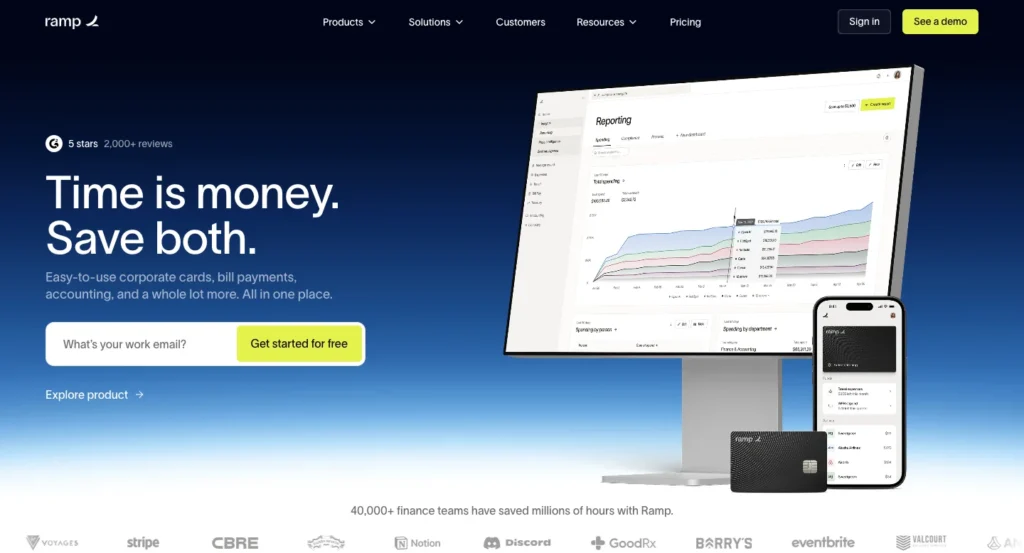
6. Ramp – AI-Powered Expense Management
Expense reports are a nightmare for most employees and finance teams. Ramp turns them into a fully automated process. It’s an AI-first spend platform with corporate cards, bill-pay, and reconciliation built-in.
Why it matters:
Ramp doesn’t just capture receipts. It enforces policy in real-time and flags duplicate or suspicious charges before they hit your books.
Finance use cases:
- Auto-match receipts to expenses.
- Block out-of-policy or duplicate transactions.
- Identify unused SaaS subscriptions eating your budget.
Real-world example:
A mid-size tech firm used Ramp to track SaaS subscriptions and discovered $120,000 in unused licenses they were still paying for.
Best for: Fast-scaling companies trying to control spend.

7. Brex – Smart Corporate Card & Spend Control
Brex takes a slightly different approach to spend management. Its platform focuses on real-time budget enforcement with virtual cards and AI-driven spend insights.
Why it matters:
Instead of catching overspending after it happens, Brex prevents it in the first place.
Finance use cases:
- Issue virtual cards tied to department budgets.
- Enforce real-time spend caps per vendor.
- Get AI insights into spending anomalies.
Real-world example:
A global startup scaled into 20+ countries using Brex. Finance leaders set region-specific budgets and avoided messy reimbursement processes altogether.
Best for: Global, fast-growing teams needing scalable spend management.
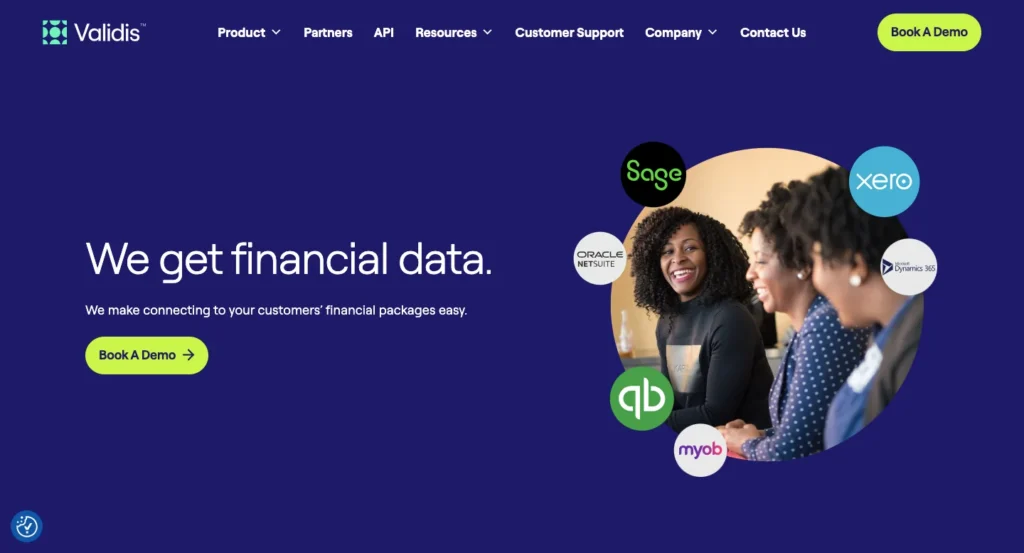
8. Validis – Financial Data Extraction at Scale
Data extraction is painful when clients use 10 different accounting systems. Validis solves that by securely pulling standardized data from platforms like QuickBooks or Xero.
Why it matters:
It turns messy accounting data into clean, audit-ready reports in minutes.
Finance use cases:
- Prepare client data for audits or loan underwriting.
- Run compliance checks on standardized GL and P&L data.
- Aggregate financials across multiple entities.
Real-world example:
Audit firms using Validis reported cutting data collection and standardization time by 50%, freeing staff for higher-value analysis.
Best for: Audit and assurance firms, lenders, and compliance teams.
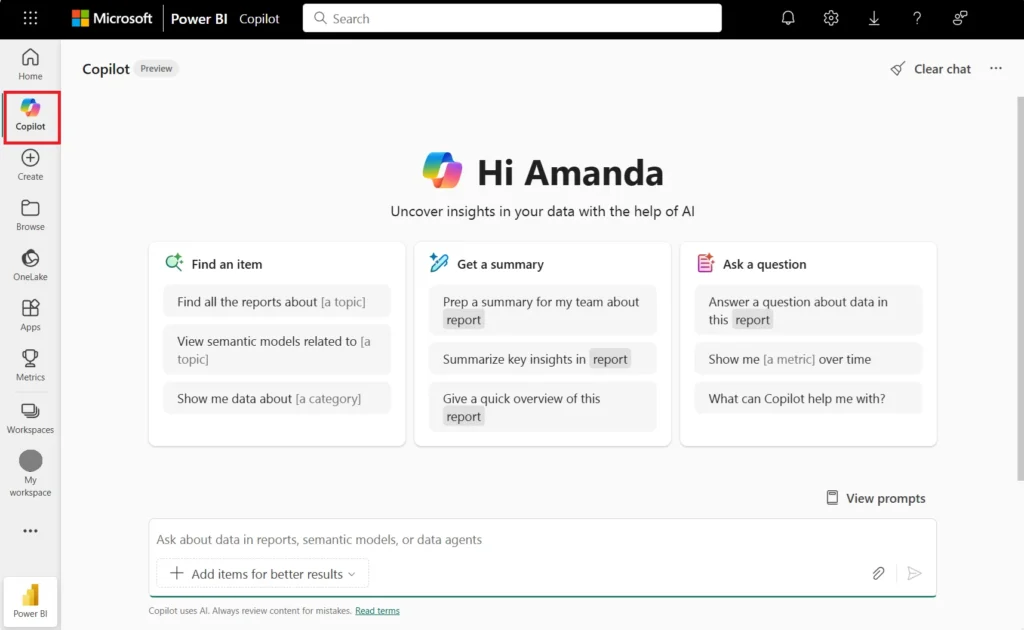
9. Power BI with Copilot – Ask Finance Data in Plain English
Power BI is already a finance favorite for dashboards. Add Microsoft Copilot, and suddenly you can ask financial questions in plain English and get instant insights.
Why it matters:
Not everyone in finance is an analyst. With Copilot, even business managers can run analysis without SQL or formulas.
Finance use cases:
- Ask: “Show revenue variance by region Q2 vs Q3” → get instant chart.
- Generate written financial commentary automatically.
- Build dashboards that refresh in real-time with ERP data.
Real-world example:
A retail finance team used Power BI with Copilot to generate weekly variance commentary for executives, cutting reporting prep by 80%.
Best for: Teams that need accessible, self-service analytics.

10. Alteryx – No-Code Analytics for Complex Financial Data
When financial data lives across multiple ERPs, CRMs, and systems, Alteryx becomes your best friend. It’s a drag-and-drop platform for cleaning, blending, and modeling huge datasets.
Why it matters:
You don’t need IT or data science teams to handle complex financial analysis anymore.
Finance use cases:
- Automate reconciliations across multiple systems.
- Blend transactional, ERP, and CRM data into one model.
- Run advanced risk and scenario models without coding.
Real-world example:
A multinational used Alteryx to reconcile global ERP data during quarterly close, cutting reporting delays by 10 days.
Best for: Large finance teams with complex, high-volume data.
Choosing the Right AI Tool for Your Finance Team
There’s no single “best” tool, it depends on your needs.
- Audit-heavy teams: Start with DataSnipper or MindBridge.
- Compliance-focused enterprises: Workiva is unbeatable.
- FP&A leaders: Datarails or Cube will save weeks each quarter.
- Spend control: Ramp or Brex reduce waste before it happens.
- Analytics-driven teams: Power BI with Copilot and Alteryx unlock deeper insights.
Start small. Pick one tool that integrates smoothly with your existing workflow, prove its ROI, then expand.
Conclusion
Finance isn’t just about closing books anymore. It’s about catching risks before they blow up, proving compliance, and providing insights that drive strategy.
The right AI tools for finance free up your team to do exactly that. Whether it’s automating reconciliations in Excel, flagging fraud before it spreads, or building forecasts that adapt in real-time, these tools are already reshaping the way finance works.
The takeaway? Don’t wait for your competitors to outpace you. Try one tool that solves your biggest pain point today and see how quickly AI can pay for itself.
You May Also Like:
- 10 Best AI Tools for Product Managers in 2025 | Reviews & Use Cases
- Best AI Note Taking Tools 2025 | Free & Paid Options Reviewed
- Remaker AI Tools Review (2025): Free Face Swap, Headshots & 25+ AI Features
- Z.ai Review 2025: Free AI Tool for Coding, PPTs & API Access